

 What is it that attracts us to sunken ships? Whether treasure ships or WW2, the fascination seems endless and demands a search. If found; explored.
What happened to the ship and it’s crew? Was it a battle? Was it a hurricane like the one in which the Marguerite went down?
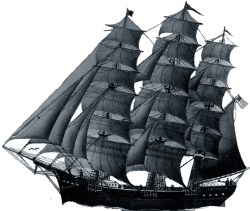
 My grandfather, son of the captain, was first officer abroad the Marguerite about to cross the equator “some ten of fifteen miles west of Lagos,” (aka the gold, ivory, and slave coast) on a starboard tack when a typhoon struck the ship and she down, stern first. My grandfather always classified the Marguerite as carrying general cargo. No treasure there–we think!
Books have been written and websites dedicated to those ships who were, however, many hundreds (or thousands) of them. Recent discoveries disclose the bounty aboard when they went down.
 In July 2014, Reheana Murray wrote of a Florida man who discovered a “priceless” religious artifact from a shipwreck 300 years ago off the coast of Ft. Pierce called a “Pyx.” The Spanish artifact was used by priests to hold the communion host, according to Brent Brisben, Operation Manager, of the Queens Jewels. The shipwreck was one of several galleons packed with treasures bound for Spain when it went down in a hurricane in 1715.
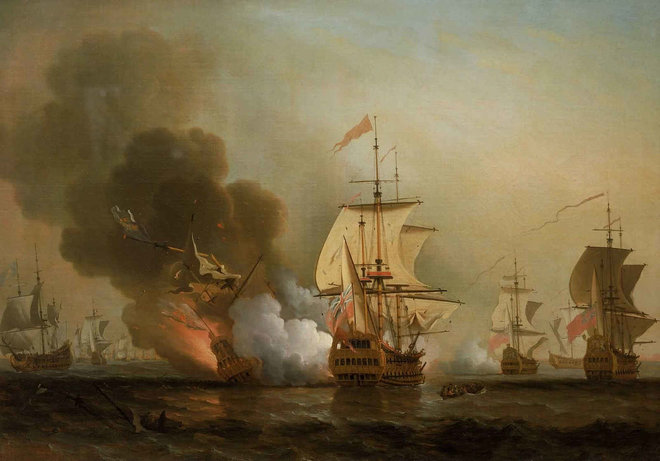
Credit: Samuel Scott, Public Domain
The San José, a behemoth equipped with 60 cannons and 600 souls aboard held treasure from the mines of Peru that was headed for Europe (unescorted?!) when it was confronted by four English ships. The treasure was meant to help fund the Spanish and French against the English in the War of Spanish Succession. Oops!
The charm and attraction of the tales romanticizes a horrific occurrence some time in history, but it doesn’t detract from the appeal of discovery. Still, the pictures and stories will continue to remain an attraction. Coasts of the US hold many more secrets and so many more stories yet to come. Have you read a good historical sailing novel lately? Want to share? ©2017 Virginia Williams

 Rosepoint Publishing