

Introduction
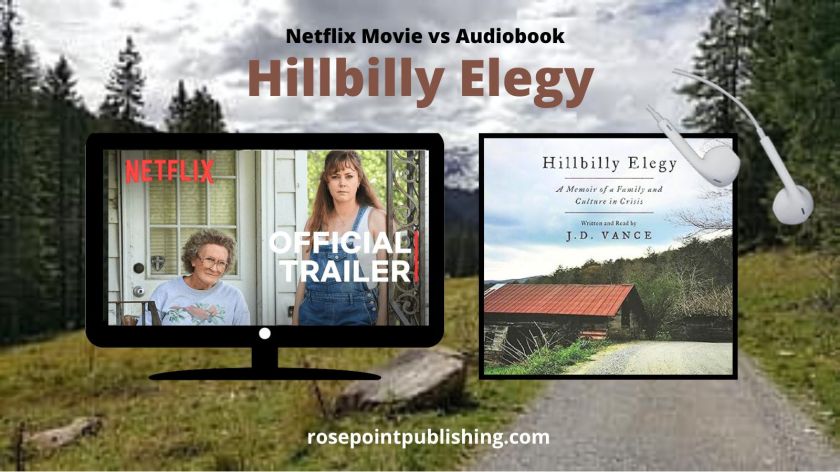
With my recent discovery of both the audiobook at my local library and the movie on Netflix (not sure for how much longer), I thought it a good time to post another Movie vs Book article. Nothing here advocating any candidate. That is not my intention. It’s a look at the book and the Ron Howard film the book generated.
The Movie
A Ron Howard film directed and produced (with partners), Howard put together a powerful cast of actors. Once again, a sharp divide between critics opinions and audience reviews. Some said it veered too far off the novel—I felt it followed fairly close. There are always little deviations, but the film did not lose the book’s essence. For his efforts, he won the Golden Raspberry Award. (really?!)

Glenn Close plays the grandmother, Mamaw, who turned in a remarkable performance using facial expressions and her eyes to cement the tension of the scene. She affected the walk of a long-suffering grandmother doing the best she could. One of the five most nominated actresses for an Oscar; lost Best Supporting Actress that year, also nominated for several other awards including the Golden Globe.
(“I’ll cancel your birth certificate!”)

Amy Adams, given the difficult role of JDs mother, also continues to stretch her acting chops, turning in a compelling performance as Bev Vance. Hers was considered the leading role. Again, though often thought a strong contender, has been denied either the nomination or the win come Oscar time. There is some controversy whether or not this should have been her turn—apparently not.

Gabriel Basso, who plays the adult J D Vance, would have been a Navy Seal had he not experienced a torn labrum. Beginning as a child actor, he has secured three nominations and two wins. Easily recognizable now for his latest action thriller series, also on Netflix, The Night Agent, he’s been active in both film and television.
I’m a little puzzled over the controversy this film generated. Was it just too honest? Reviews and opinions are all over the place. Everyone comes from a different experience and applying the message from the film might generate a range of conflicting judgments. And that’s okay. We’re all entitled.

The Book
First time I’ve noticed the Amazon ratings 106,821 with 4.4 stars and a 3.9 on Goodreads with 426,652 ratings in the heading.
#1 Best Seller in Sociology
A Memoir of a Family and Culture in Crisis
My Thoughts
Of course, when he was nominated the VP candidate, I had to look for information on him and found this memoir. I’m a fan of books about the Appalachian area and memoirs anyway. When I discovered it among the audiobooks at my local library, I jumped on it.
To say I was a bit surprised would be an understatement. It’s a raw, no holds barred and very graphic account of his childhood to adulthood. (While my dad’s side hailed from Missouri, I couldn’t help but find so many similarities in the description of family life, it was scary. Apparently, a common trait among the folk from those eastern hills.)
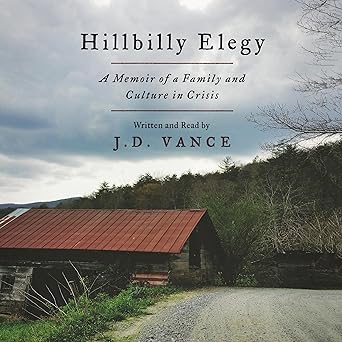 Largely raised by his grandmother, it was her philosophy of life that instilled a fierce devotion and loyalty to family. Whether now well Yale educated or not, ex-Marine or not, a life in two worlds, it would appear that it is his Appalachian bearing that still wields the powerful hammer.
Many of his conservative ideas are controversial but he comes from a different universe than most of his congressional billionaire-building cohorts. If he appears to exhibit some pride by making it from extreme poverty, drug use, and alcohol to his station today, perhaps he has a right. (I never forgot where I came from and thinking that this was as good as it was going to get was a plateau I never overcame. Still, I’ve been a lucky one.)
And so was he. Although his message may be one of taking responsibility for oneself—and stop the blame game—he managed to receive some lucky breaks. Supportive family, a Yale education, the right mentors. He tends to some deep introspection and certainly makes a lot of astute observations, offering some stats and info to back his theories and analyses of how or why the country got so divided.
Thought-provoking, heart-pounding narrative that describes the lows, the loss of hope, and then the swing to achievement and triumph.
Curious? It’s definitely worth a listen.
Audiobook (Blurb)
Winner, 2017 APA Audie Awards – Nonfiction
From a former marine and Yale Law School graduate, a powerful account of growing up in a poor Rust Belt town that offers a broader, probing look at the struggles of America’s white working class.
Hillbilly Elegy is a passionate and personal analysis of a culture in crisis – that of white working-class Americans. The decline of this group, a demographic of our country that has been slowly disintegrating over 40 years, has been reported on with growing frequency and alarm but has never before been written about as searingly from the inside. J. D. Vance tells the true story of what a social, regional, and class decline feels like when you were born with it hung around your neck.
The Vance family story begins hopefully in postwar America. J. D.’s grandparents were “dirt poor and in love” and moved north from Kentucky’s Appalachia region to Ohio in the hopes of escaping the dreadful poverty around them. They raised a middle-class family, and eventually their grandchild (the author) would graduate from Yale Law School, a conventional marker of their success in achieving generational upward mobility.
But as the family saga of Hillbilly Elegy plays out, we learn that this is only the short, superficial version. Vance’s grandparents, his aunt, his uncle, his sister, and most of all his mother struggled profoundly with the demands of their new middle-class life and were never able to fully escape the legacy of abuse, alcoholism, poverty, and trauma so characteristic of their part of America. Vance piercingly shows how he himself still carries around the demons of their chaotic family history.
A deeply moving memoir with its share of humor and vividly colorful figures, Hillbilly Elegy is the story of how upward mobility really feels. And it is an urgent and troubling meditation on the loss of the American dream for a large segment of this country.
The Author
 J. D. Vance grew up in the Rust Belt city of Middletown, Ohio, and the Appalachian town of Jackson, Kentucky. He enlisted in the Marine Corps after high school and served in Iraq. A graduate of Ohio State University and Yale Law School, he was elected to the United States Senate representing Ohio in 2022. In 2024, he became the Republican nominee for Vice President. Vance lives in Columbus, Ohio, with his family.
Book Details
Genre: Ethnic Studies, Poverty, Sociology
Publisher: HarperAudio
ASIN: B01EM4ZJBO
Listening Length: 6 hrs 49 mins
Narrator: J. D. Vance
Audible Release: June 28, 2016
Source: Local Library (Audiobook Selections)
Title Link: Hillbilly Elegy [Amazon]

Nominee for Best Memoir & Autobiography (2016)
Overall Impression
I greatly enjoyed the audiobook, narrated by the author, his scrapping childhood enough to break or harden any but the most hardy individual. I listened with interest to his assessment of the divide that exists in the country, critical of many government practices. His is an honest voice I’m sure heard with a jaundiced ear—I doubt he has a problem suppressing his thoughts.
Conclusion
Both the film and the audiobook (and I’d recommend the audiobook) are worth the time for the read and/or watch.
The actors turn in a credible performance—I was especially impressed with Glenn Close—not usually one of my favorites. Amy Adams sold her role of a mother whose lifestyle cemented the inability to care for her children. The critics hated the flick. Audience reviews were more generous. (And by the way, those iconic glasses worn by Glenn Close were Mamaws own glasses, loaned to the actress for her part.)
Did the movie go overboard with the castigation of the Appalachian people in general? Possibly. It’s a searing indictment of the predicament of the poor of the region. In the blame game—who is responsible? A government turning a blind eye? The people themselves? Is Vance pushing the edict, “If I got out, so can you?” Yeah, maybe, or it may be more, “I got out and look at me now!” Hoorah!
In any case, if you can separate the politics and just enjoy the story, either the book or the movie is gripping and powerful entertainment and I’d recommend both.
©2024 V Williams

Credits: Sources from Google search
Amy Adams
Glenn Close
Gabriel Basso
General info, imdb.com
 Title: 6 Life Changing

 I’ve spoken before of the “Grand Ole Lady” (the Lake County Courthouse), resplendent with the striking brick red facade (love this building!), but probably not The John Dillinger Museum, a focus of the 1930’s with Dillinger memorabilia enclosed within the building in Crown Point. If you recognized that as being in northwest Indiana, you’d be correct.
  Admitted to the union in 1816, Indiana can claim a number of authors, many of whom hail out of Gary, about as far north as you can go without wading out into Lake Michigan. Of the well-known Jackson family born in Gary, Janet gained fame as a singer/songwriter and LaToya as both author and songwriter.
 Alex Karras, who gained fame as a pro-ball player, wrote a journal that was published in the Detroit Free Press and much later, a novel entitled “Tuesday Night Football.”
 Kurt Vonnegut Jr, born 1922 in Indianapolis, wrote for more than 50 years and although he published many novels, plays, short stories, and non-fiction, was probably most famous for the dark “Slaughterhouse-Five.”
 Rosepoint Publishing