

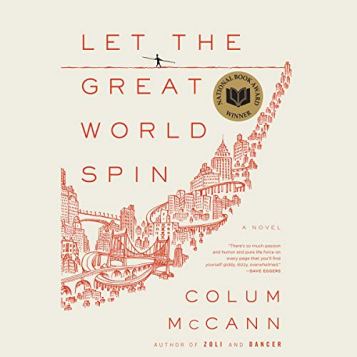
Let the Great World Spin by Colum McCann

A Reading Ireland Month book
“The world spins. We stumble on. It is enough.”
Book Blurb:
In the dawning light of a late-summer morning, the people of lower Manhattan stand hushed, staring up in disbelief at the Twin Towers. It is August 1974, and a mysterious tightrope walker is running, dancing, leaping between the towers, suspended a quarter-mile above the ground. In the streets below, a slew of ordinary lives become extraordinary in best-selling novelist Colum McCann’s stunningly intricate portrait of a city and its people.
Let the Great World Spin is the critically acclaimed author’s most ambitious novel yet: a dazzlingly rich vision of the pain, loveliness, mystery, and promise of New York City in the 1970s.
My Review:
It was in August 1974 when 24 year old Frenchman Philippe Petit made it his “le coup” to illegally walk on a high wire across the top of the twin towers a total of eight times, the “artistic crime of the century.” And the feat was so bizarre, so over-the-top astounding that a film was released about it October 2015 called “The Walk.” I wrote a short article about the headline capturing story on July 2, 2016, not knowing that Colum McCann released this book in January 16, 2015. To be fair, I have not viewed the film.
It wasn’t long before I realized the book was about a particular group of people who may (or may not) have been impacted by this stupendous feat. The first half of the book is very slow, and for me, disjointed. I was trying to figure out how these characters had anything to do with the event that was unfolding before their eyes, or in some other unrelated capacity, connecting them. Indeed, for quite some time it didn’t.
It wasn’t a book about the feat itself or the man who walked the high wire. It was a deep-diving story that eventually begins to form a wire itself—uniting the stories of those five or six of the sixteen plus million people in mid-70s New York City.
 You probably couldn’t find a more disparate group of people to dissect, from Irish priest (okay, monk), to mother and daughter hookers. Tillie’s story is graphic and profane but at least she finally breathed some much needed energy into a novel long in the tooth, reveling in finding a topic and expanding on it sixteen different ways, “the wind of the…, the trees of the…, the whatever…eventually just feels like filler to me and indeed, this narrative manages to extend beyond fifteen hours. Not a style I particularly enjoy—the constant philosophizing. It seemed dark, depressing. And when I thought it would get on with the story simply introduced yet another new character that was then studied to within of that life with no discernible bond to any of the previous characters.
I especially had a problem with the “Nam” references since the CE is a veteran of that era; we lived through it. But at least I could identify with the gold star mothers since I lost a brother during that time, not as a mother, but a sister. A pain that gradually dulls but never lets go and also gripped the mothers in this emotional support group.
The author does draw the characters finally together in a cohesive, sensitive manner—a study of the people, of the time. Perhaps not the event, but event driven? In the end, we also get the inside story of the judge, laid open and bare, warts and all, the storyline tied by his wife’s support group, while he’s ecstatic he got the defendant of the year in his court–sufficient to relieve his judicial boredom.
Well, mercy. One final stinging epithet.
Book Details:
Genre: Urban Fiction, Fiction Urban Life, Family Life Fiction
Publisher: Random House Audio
ASIN: B00SC80QC4
Listening Length: 15 hrs 15 mins
Narrator(s): Richard Poe, Gerard Doyle, Carol Monda, Johanna Parker, Ramon De Ocampo
Publication Date: January 16, 2015
Source: Local Library (Audiobook Selections)
Title Link: Let the Great World Spin [Amazon]

Rosepoint Publishing: Three-point Five Stars 
 The Author: [Goodreads] Colum McCann is the author of three collections of short stories and six novels, including “Apeirogon,” due to be published in Spring 2020. His other books include “TransAtlantic,” “Let the Great World Spin,” “This Side of Brightness,””Dancer” and “Zoli,” all of which were international best-sellers.
“Let the Great World Spin” won the National Book Award in 2009. His fiction has been published in over 40 languages and has appeared in The New Yorker, The Atlantic Monthly, GQ, Paris Review and other places. He has written for numerous publications including The Irish Times, Die Zeit, La Republicca, Paris Match, The New York Times, the Guardian and the Independent.
Colum has won numerous international awards and has been a bestseller on four continents. He is a member of the American Academy of Arts and Letters, as well as the Irish association of artists, Aosdana. He has also received a Chevalier des Artes et des Lettres from the French government. He is the cofounder of the global non-profit story exchange organisation Narrative 4.
In 2003 Colum was named Esquire magazine’s “Writer of the Year.” Other awards and honors include a Pushcart Prize, the Rooney Prize, the Irish Independent Hughes and Hughes/Sunday Independent Novel of the Year 2003, and the 2002 Ireland Fund of Monaco Princess Grace Memorial Literary Award. He was recently inducted into the Hennessy Hall of Fame for Irish Literature.
His short film “Everything in this Country Must,” directed by Gary McKendry, was nominated for an Academy Award Oscar in 2005.
Colum was born in Dublin in 1965 and began his career as a journalist in The Irish Press. In the early 1980’s he took a bicycle across North America and then worked as a wilderness guide in a program for juvenile delinquents in Texas. After a year and a half in Japan, he and his wife Allison moved to New York where they currently live with their three children, Isabella, John Michael and Christian.
Colum teaches in Hunter College in New York, in the Creative Writing program, with fellow novelists Peter Carey and Tea Obreht.
Colum has completed his new novel, “Apeirogon.” Crafted out of a universe of fictional and nonfictional material, McCann tells the story of Bassam Aramin and Rami Elhanan. One is Israeli. One is Palestinian. Both are fathers. Both have lost their daughters to the conflict. When Bassam and Rami learn of each other’s stories they recognize the loss that connects them, and they begin to use their grief as a weapon for peace.
In the novel McCann crosses centuries and continents. He stitches together time, art, history, nature and politics in a tale both heartbreaking and hopeful. Musical, cinematic, muscular, delicate and soaring, Apeirogon is a novel for our times.
Sign up for Colum’s newsletter: http://bit.ly/mccannsignup
Website: http://www.colummccann.com
©2022 V Williams 

 Rosepoint Publishing