 I gave up on Smashwords this week.
Their Wide Variety of Formats
I’ve monitored my stats almost every day since I downloaded the first manuscript for my grandfather back in 2012–and the stats are dismal. At the time, Smashwords seemed like a good addition to my marketing plan when I published with Amazon and their Kindle site. If you aren’t already aware of Smashwords, they publish and make available ebooks bestowing freedom to authors to set their own prices. Smashwords further makes available your digital downloads to Nook (Barnes & Noble), Apple IBooks, Scribd, Oyster, and Kobo, and allows downloads in EPUB, PDF, and MOBI formats.
It’s not as if they aren’t busy trying to help promote their authors and introduce them to new readers. When writing this post, they were currently running (July 1 – July 31) their annual Summer/Winter Sale. In view of the complete lack of activity (probably not their fault) on any of my listings, I declined to join the sale. They keep up dialog in their “Site Updates” as well as “Press Releases” in which they recently noted Smashwords and Publishers Weekly joined to launch an ebook best seller’s list.
Free Downloads
I have to hand it to Mark Coker. It is not as if he hasn’t tried getting some of us off the sidelines. His free downloads, “Smashwords Style Guide” and “The Secrets to Ebook Publishing Success” are comprehensive and indispensable for an Indie author as the publishing format on Smashwords is neither as easy nor forgiving as Kindle.
Spoiler Alert: You have to sell at least $10.00 in royalties to warrant payment. After the first blush of sales were over, I was still under that amount and will apparently carry the embarrassing sale record to infinity. This is no small entity. They are dynamic; have published over 416,638 books in all genres with over 65,000 of those books free.
So, what’s a mother to do? Guess it’s time to begin a new campaign!
Editorial Reviews
It all began this week with a review for a new author buddy of mine who introduced me to a couple nifty little Amazon website author page opt-ins I hadn’t previously noticed. Sometimes, you just have to hit me upside the head! Carlyle Clark, author of Children From Dark Houses, immediately included in his “Editorial Reviews” a couple sentences from my recent review of his book. Those Editorial Reviews show up prominently near the top of the book information. It succinctly brings to the surfer’s attention pertinent blurbs from your reviews. I loved it!
Reviewers Information
 Also, I got to looking at (Amazon) Reviewers information. As I mentioned before, I’ve been receiving many requests for reviews. Therefore, the time came for me to expand my reviewer information and add a link to connect me from Amazon. Learning new stuff is exciting, isn’t it? Ah, but as seniors sometimes tend to do, I digress.
So then, what was the whole point of “unpublishing” my books from Smashwords? Have I succumbed to KDP? It’s just easier. Smashwords didn’t make sense for my little books and having that link also limited some promotional abilities from Amazon. I needed Amazon more.
©2016 Virginia Williams 


 On Sept 27, 2015, I wrote regarding my introduction to NaNoWriMo, the National Novel Writing Month website created by Chris Baty in 1999 and succeeded by Executive Director, Grant Faulkner in 2012. Think you still have a book in you? November is the month to find out. Just 50,000 little words, only 1,667 words per day in 30 days. Think you can do it? How about if you had help, a coach, or several coaches, hints, information, word count, encouragement, and other participants pushing to complete their book in the same month? It’s a band of engagement–join the fun!
 No, this blog is not all about dogs, it just seems that way lately. I was struck recently by a couple pictures I saw of dogs dressed in human clothing and dogs painted to look like other animals.
  This is the third time she has had a sore paw (she gets stickers between her toes) and the second for the hood and once again, I was struck with how difficult it is for her to negotiate her normal routine. That hang-dog look is obvious; the change in attitude a dog exhibits upon being “dressed.” Is it really possible they can be embarrassed or demoralized? Ask most canine owners and they would say YES! (Once again creating an anthropomorphizing quality to a canine.)
 While clothing or bootees might be a good thing in the winter for some thin, shorthaired or small breeds, it can in some instances allow the dog to overheat.


 Taking a commuter train, I am sure, is somewhat akin to riding the Greyhound. There is an unmistakable impression that follows–the “train people.” But there are a whole myriad of train people; there were the train people that caught the rails during the depression hooking a ride to wherever the train was going, and the train people who refuse to fly–taking the “smell the roses” route of transportation–and then there are commuters.
 We became one of the faceless crowd as we joined the group boarding the South Shore Line in Portage, Indiana, for the Millennium Station in downtown Chicago yesterday for the bargain price of $4 one way per person. (It was built between 1901 and 1908.) The line that operates between South Bend International Airport and downtown Chicago is now an electrically powered inter-urban commuter rail service operated by the Northern Indiana Commuter Transportation District.
 There were people pulling carry-on bags we used to call luggage. There were students heavy laden with backpacks, shoppers, tourists, and people like us–out to enjoy a day in Chicago. The train, thankfully, was equipped with WiFi, but unfortunately didn’t keep everyone occupied, as we were treated to the lady on the way into Chicago on a non-stop conversation that no one in the car had a problem hearing. Likewise, a younger man on the way back had to involve us in this profanity filled, F-word laden conversation. At least the lady’s conversation included sage, age-driven advice. I didn’t learn a thing from the guy. ©2106 Virginia Williams


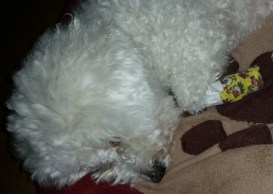 Lots of blood and a visit to super-vet Dr. McPheron of Crown Point, and it was decided Frosty will live. Our son asked how “Stubby” was doing, but it’s apparently not more than a lost toenail. We have something to give her for pain control and she appears to be sleeping comfortably at present.
 Rosepoint Publishing